If you had unlimited money, would you consider buying a dinosaur fossil? It might sound silly, but believe it or not, someone actually did.
Yep. You read it right!
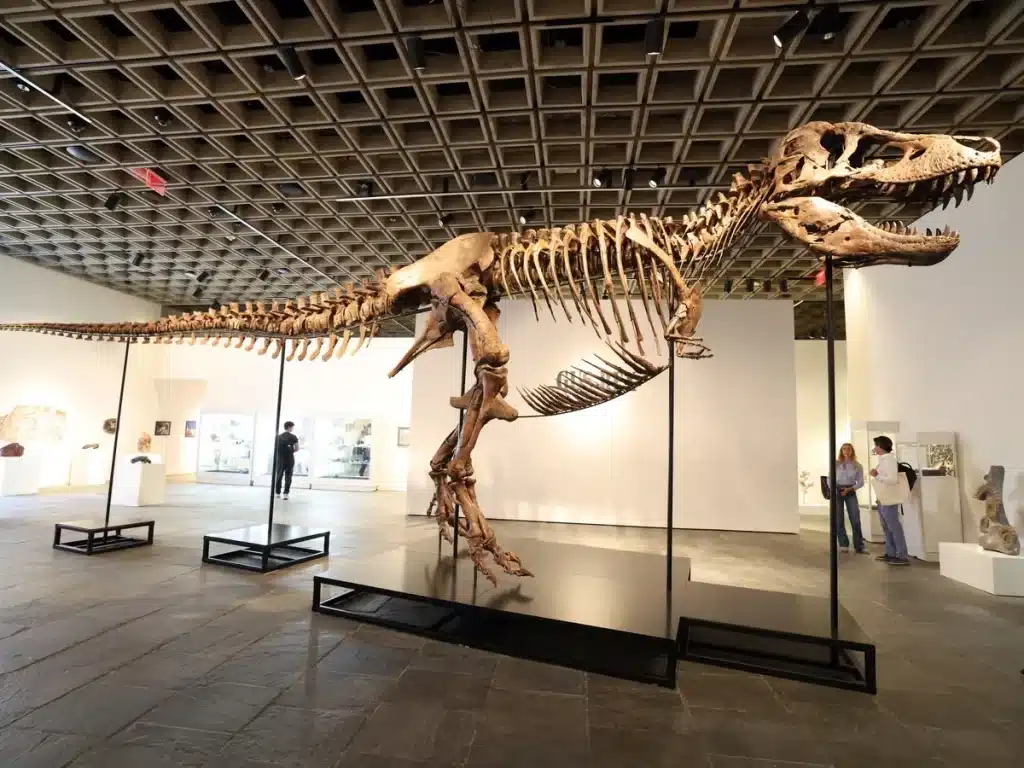
A Tyrannosaurus Rex nicknamed Gus was sold for $50.1 million (£37.4m) at an auction in New York City on July 14. 2026. This makes Gus the most expensive dinosaur ever sold.
Gus is an amazing fossil find because he is one of the most complete T. Rex skeletons ever discovered.
He’s about 38 feet long and has 183 fossilized bones, making him about 63% complete. That size and condition make him rare for both scientists and collectors.
Gus was discovered on a cattle ranch in South Dakota and was named after rancher Gary “Gus” Licking. It was found in an area known for dinosaur fossils.
While Gus represents only about 63% of the original bones, it includes a very impressive skull with most of its teeth still intact.
His discovery took a dedicated team six years, from digging him up to properly reconstructing him.
The team worked hard over three summer seasons to carefully collect and clean his bones.
Before Gus, the record for the most expensive dinosaur sold at auction was held by a stegosaurus named Apex, which was bought for $44.6 million in 2024.
Apex
Gus’s sale doubled the price experts thought he would go for, and the buyer has decided to remain anonymous.
However, Gus’s big sale has started a debate about whether dinosaurs should be kept in private collections or displayed in public museums.
Some scientists, like Paul Sereno of the University of Chicago, think that rare fossils like Gus should be shared with everyone rather than kept by rich people.
Sereno believes that fossils are important cultural artifacts that should belong to everyone, not just to people who can afford them.
Others, like Cassandra Hatton, head of science and natural history at Sotheby’s, argue that in the U.S., if you own the land where a fossil is found, you can sell it.
This rule differs from that of many countries, where fossils are considered public property. Some believe that selling fossils can help fund scientific research and fieldwork.
Gus is now alongside famous dinosaurs like “Sue,” on display in Chicago, and “Stan,” in Abu Dhabi.
Both of these skeletons have also made headlines for their auction prices. Sue sold for $8.36 million in 1997, while Stan fetched $31.85 million in 2020.
Did you know that in the US and UK, it’s legal to buy and sell dinosaur fossils? But in places like China, Mongolia, Brazil, and Argentina, it’s illegal to export dinosaur fossils because they are considered important to their cultures.
People really want to get their hands on dinosaur remains, especially famous ones like the T. rex.
How about you? Do you think dinosaur fossils should be sold to private collectors or stay with public museums?


 Written by